

We all have good days and bad days, and most of us realise that a tired day is often a bad day. Holidays and time out are important for everyone, and luckily, in the UK at least we understand that.
A recent report by Mercer analysed the legal entitlement of workers in 64 countries around the world to time off. The results were handily summarised in a map by the lifestyle brand Thrillist:
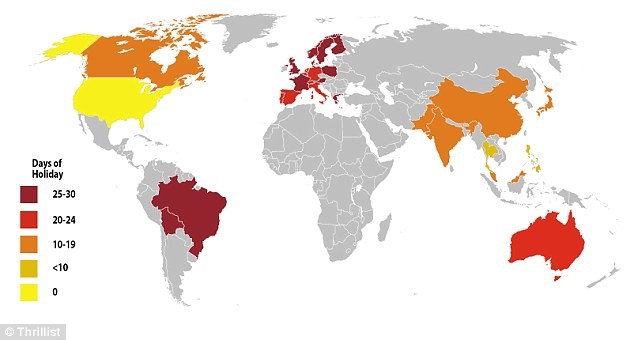
http://www.mercer.com/insights/view/2014/who-gets-the-most-time-off-by-law.html. Figures are based on employees with 10 years of service who work a five day week
UK employers, it turns out, are some of the most generous when it comes to annual leave. This is good news; time away from work can be as important as work itself. At Space2BE we believe strongly in corporate wellness – we believe that to reach peak performance and sustain it consistently, people need to be of healthy mind and body. Our work in corporate wellness covers mental, physical and emotional resilience, and we’ll be exploring these themes some more in the coming weeks. But let’s start with leaders – because just as doctors make the worst patients, leaders are often the worst offenders when it comes to taking time off.
The primary role of a leader is to make good decisions. How can you do that if you’re tired, or burnt out, or generally not at your best?
Experienced leaders often talk of the importance of taking time out to reflect and regain perspective, which allows them to make better decisions. The book What Do Leaders Really Do? (Grout and Fisher, Capstone, 2007) looked at the practical side of leadership through detailed interviews with 17 leaders in a wide range of disciplines. Without fail, all of the leaders emphasised how important it is to look after themselves.
That means creating time and space for yourself to think, in whatever forms best works for you. Every leader is different; Margaret Thatcher was famous for only needing three or four hours of sleep a night and seemed to thrive on the pressure, while Field Marshall Montgomery used to insist on eight hours sleep in comfort whenever possible, on the basis that his brain had to function at its best if he was going to protect the lives of his men.
In the book, Dame Stella Rimington said she made some of the best decisions while head of MI5 while walking her dogs; while Lord Coe, Chairman of the London Organising Committee of the Olympic and Paralympic Games, said that exercise was the only thing that was never moved from his diary. ‘I can be tossing and turning over three or four things but when I go out for a run I can usually work it out and I wonder why I ever thought they were an issue in the first place,’ he said.
Many leaders say that the pressure of their role means that, unless they actively create time for themselves, their ability to innovate can suffer over time. In other words, leaders need to take time out to work on the business, looking ahead to anticipate future changes and opportunities, rather than in the business. When did you have your last good idea? We’ll wager it wasn’t at the office…
“… saying that you don’t have time to improve your thoughts and your life is like saying you don’t have time to stop for gas because you’re too busy driving. Eventually it will catch up with you.” Robin Sharma
