

I am sure many of you will be able to relate to a recent coachee of mine who said: ”I sat at my computer to log on the other day and couldn’t remember my password. I’ve had the same password for a month. I am so tired I can barely think straight”.
When an organisation is faced with employees experiencing such feelings and fatigue it is a challenge to understand how to help in a meaningful way. Contextually, we understand that our global economy is such that the pressure is on. Indeed it is recognised that it is: “healthy and essential that people experience challenges within their lives that cause levels of pressure and, up to a certain point, an increase in pressure can improve performance and the quality of life” (CIPD 2013) However, the problem arises when the pressure becomes excessive and: “it loses its beneficial effect and becomes harmful and destructive to health” (CIPD 2013). Are you or any of your team stressed?
Signs of Stress
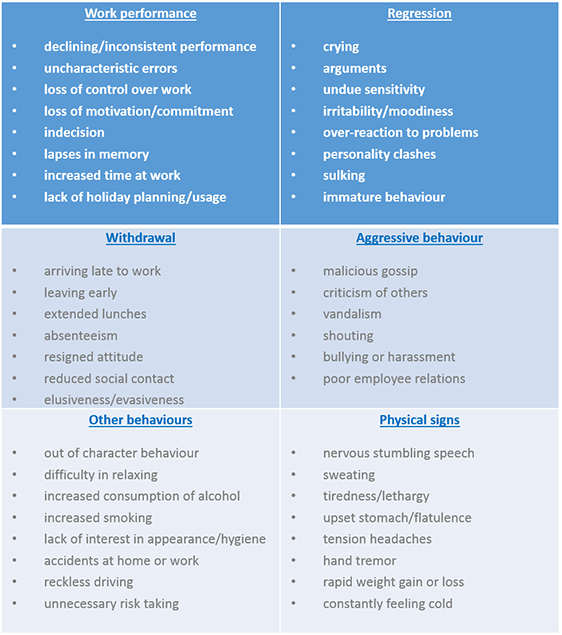 Source: CIPD fact sheet (2013)
Joan Borysenko (PhD.) a Harvard-trained biologist and psychologist who is often described as a world expert on stress, also writes about ‘burnout’ and highlights the difference between the two:
“When you’re stressed out, you keep chasing the same old carrot, whatever that may be for you. But when you are burned out, you eventually give up the chase. The hope that you can create a meaningful life fizzles out, and you find yourself sitting in the ashes of your dreams” (Borysenko 2011).
It seems that burnout is “learned helplessness” and is in essence a “motivational problem”.
Managing stress will not deal with the burnout challenge. For this we may need a more holistic approach.
Last year we formalised the ‘corporate wellness’ arm of our business.
The Stages of Burnout
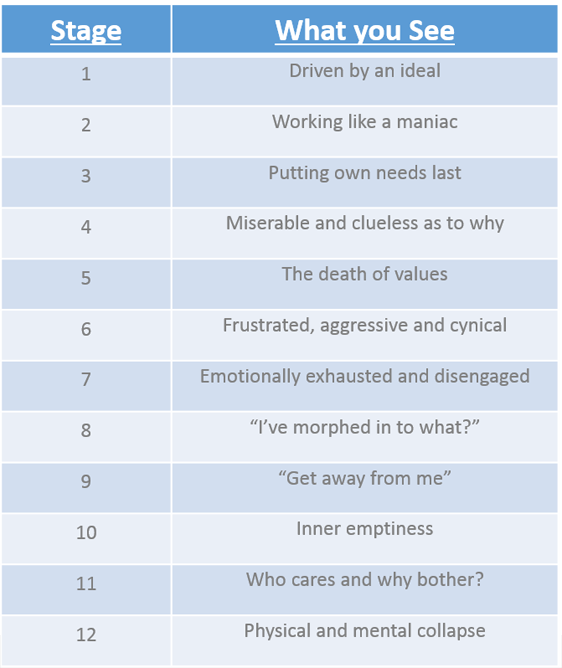
Source: Borysenko PhD (2011) Stress and burnout are a reality of business life and speaking as a Management Consultant and ex-HR practitioner I would rather be on the front foot as opposed to the back-foot when considering employee well-being. We encourage our clients to integrate corporate wellness principles in to the ‘people infrastructure’ of their business and their culture through policies, structures, ways of working, employee training programmes and leadership development. Ultimately this leads to improved rounded and grounded leadership and healthier and energised employees leading to higher employee engagement, innovation and productivity.
If you have team members showing signs of stress or descending in to the ‘burnout’ inferno it is time to take a new approach and create sustainable solutions.
As Borysenko so eloquently said:
“Hell is a bad place to pitch a tent”
Want to find out how you can do things differently? Contact us at connect@space2be.co.
References:
Stress and mental health at work: CIPD factsheet (2013).
Fried: Why you burn out and how to revive. Joan Borysenko PhD. Hayhouse UK. (2011).
